In experiments involving drought, salt stress, and high temperature, the real differentiator in data quality is often not the treatment design itself, but rather the ability to conduct continuous observation. From a market sales and application promotion perspective, I have encountered many users in agricultural research, education, horticulture, and forestry. They typically place great emphasis on treatment settings, replication counts, and sample selection during project initiation. However, as experiments progress, the most problematic (link/stage) is precisely the observation phase. Especially in plant stress research, many key responses are not defined by "whether they occurred," but rather by "at what time, at what rate, and under what environmental conditions they occurred." This is why more and more teams are beginning to re-evaluate the value of portable photosynthesis meters in continuous monitoring.
I. Why Stress Experiments Always Get Stuck on Continuous Sampling
The most common pain point in stress experiments is not the inability to measure, but the difficulty in continuous and stable measurement. Taking drought stress as an example, changes in leaf stomatal conductance, transpiration rate, and photosynthetic rate often show significant fluctuations within a few hours or even less. If reliance on manual, timed monitoring continues, three problems easily arise:
First, high labor costs. Many experiments require measurements to be taken from artificial climate chambers to greenhouses, polytunnels, and even fields. When observing the same materials across different scenarios, personnel scheduling becomes extremely tight. Second, key time points are easily missed. Midday high temperatures, nighttime recovery, and the periods before and after irrigation are often the most valuable for research, but also the most difficult to fully cover manually. Third, equipment switching is cumbersome. Measuring environmental and physiological parameters separately not only lengthens the process but also disrupts the strict synchronicity between different data points.
From market feedback, many teams don't lack experimental ideas, but rather a truly implementable continuous observation solution. The increasing attention given to portable photosynthesis meters is precisely because they have gradually upgraded from "single-time measurement tools" to "continuous monitoring entry points." For stress experiments, whoever can capture the plant's physiological changes more completely is more likely to obtain high-quality data.
II. What Equipment Capabilities are Required for Unattended Observation?
To achieve unattended operation, the equipment must first and foremost not be "heavy." Many teachers and researchers who have used the equipment on the front lines agree that continuous monitoring is not about piling up parameters, but about having a sufficiently low barrier to entry. Even the best features are hard to realize if the equipment is large, difficult to move, and complex to install.
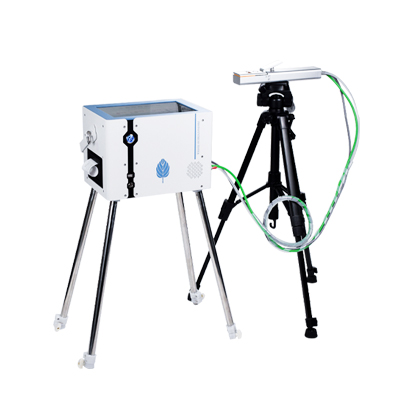
Therefore, a portable photosynthesis meter suitable for continuous monitoring must first be lightweight and portable. The main unit should measure 325×160×230mm, and with a carrying case, a single person can easily move it. The handle should be 250×30×48mm, further reducing the burden of operation during actual field sampling. For teams that need to switch between artificial climate chambers, greenhouses, polytunnels, and open fields, this portability itself translates to efficiency.
Secondly, battery life is crucial. Many stress experiments don't just measure for a few minutes; they require continuous recording over half a day or even a whole day. A 10-12 hour continuous use on a full charge means that the critical change phases from dawn to dusk can be covered as comprehensively as possible, reducing the risk of interrupting the experimental process by requiring power changes or recharging.
Furthermore, stable mounting is essential. Continuous observation does not mean someone is always present; the importance of a mounting system is often underestimated. The height of the main unit stand is adjustable, as are the height and angle of the tripod for the detection handle, making long-term unattended monitoring more feasible. Especially in high-temperature, salt-stress treatments, or in-situ field monitoring, continuous data collection after fixing the position is more stable and labor-saving than frequent handheld measurements.
III. Measuring only the environment is insufficient; photosynthetic changes must be observed simultaneously.
Many experiments have a misconception: focus on environmental monitoring first, then supplement with plant physiological data later. However, in stress experiments, knowing only temperature, humidity, and light changes is far from enough. Environmental changes are merely the background; what truly determines the plant's condition is whether the photosynthetic response chain is recorded synchronously.
The value of a mature plant photosynthesis measuring instrument lies not in "how many numbers it can measure," but in its ability to simultaneously reconstruct the continuous logic of a plant's internal physiological regulation from the external environment. Simultaneous acquisition of 15 parameters, including air CO2 concentration, ambient temperature and humidity, leaf chamber temperature and humidity, leaf surface temperature, atmospheric pressure, photosynthetically active radiation (PAR), and further parameters such as photosynthetic rate (Pn), stomatal conductance (Gs), transpiration rate (Tr), intercellular CO2 concentration (Ci), water use efficiency (WUE), respiration rate (Rd), and transpiration ratio (TR), is crucial for accurately identifying which aspect of photosynthesis is affected by stress.
For example, under high-temperature treatments, observing only an increase in ambient temperature makes it difficult to determine whether the decrease in Pn is due to stomatal closure or non-stomatal limitation causing photosynthetic inhibition. However, simultaneous recording of Pn, Gs, Tr, Ci, and WUE provides clearer analysis. Similarly, under salt stress, the interconnected changes in air CO2 concentration, leaf chamber humidity, and transpiration rate are often more informative than single endpoint data. This is why an increasing number of research teams are using portable photosynthesis meters as core equipment, rather than simply as environmental recording devices.
IV. Continuous Data Must Be "Usable": Stability is More Important Than Quantity
In market communications, the most common demand I hear is: "We don't lack data, we lack data that can be used for comparisons, articles, and to support our conclusions." This statement is crucial. Continuous monitoring with only quantity but no stability will significantly diminish its value in the long run.
Plant stress experiments place particularly high demands on instrument stability because the environment itself is subject to drastic changes. If CO2 detection is easily affected by temperature fluctuations, then seemingly dense curves may simply be equipment drift, not a true physiological response. Dual-wavelength infrared CO2 analyzers demonstrate a clear advantage here. Combining a temperature control unit and an atmospheric pressure measurement unit effectively improves the stability and accuracy of CO2 detection, reducing large fluctuations in CO2 values caused by temperature changes.
Specifically, air CO2 concentration is analyzed using non-diffusion infrared CO2 analysis, with a measurement range of 0-3000 μmol/mol and an error ≤3%FS; ambient temperature and leaf chamber temperature measurement errors can be controlled within ±0.2℃, and ambient humidity and leaf chamber humidity errors ≤±1%RH; atmospheric pressure measurement range is 30-110 kPa, with an error ≤±0.06 kPa; PAR measurement range is 0-3000 μmol/(m2·s). These parameters, while seemingly technical specifications, actually represent the comparability of data across different batches, locations, and treatments in practical applications.
For research users, the plant photosynthesis measuring instrument ultimately serves not just a one-time demonstration, but long-term research accumulation. A stable data foundation determines the validity of subsequent statistical analyses, the reproducibility of experiments, and the verifiability of conclusions.
V. How to Further Reduce Post-Processing Pressure
Truly saving manpower not only means reducing the number of people on-site, but also reducing a lot of repetitive post-processing work. Many experimental teams already expend considerable effort on data collection, yet end up spending a significant amount of time manually exporting tables, filtering data, and plotting curves – this is a hidden cost.
Intelligent interfaces significantly lower the operational barrier. Utilizing an Android operating system and equipped with a 10-inch high-sensitivity touchscreen, the measurement process is displayed in real-time, allowing for more direct on-site assessment. For researchers, there's no need to wait until returning to the office to discover data anomalies; issues can be identified on-site using Pn curves, Tr curves, light-photosynthesis curves, and humidity-transpiration curves.
Simultaneous analysis of multiple data sets is equally important. After the experiment, multiple data sets can be analyzed simultaneously, generating curves in different colors for easy comparison between treatments. This is particularly valuable for stress gradient experiments, as researchers are typically most concerned with differences in response speed and inflection points between different treatment groups, rather than isolated data points.
Data export and management methods also directly impact work efficiency. Support for WiFi wireless transmission and USB flash drive data copying eliminates the need for driver-based plugging and unplugging; simultaneously, test results can be selectively or in batches uploaded to a cloud platform for long-term data management and visualization analysis. For teams with multiple members collaborating and multiple experimental cycles running in parallel, this closed-loop management significantly reduces data fragmentation, version inconsistencies, and redundant data processing.
From an application and promotion perspective, the market value of portable photosynthesis meters and plant photosynthesis meters goes beyond simply "being able to measure," to "making continuous monitoring truly a reality." In stress experiments, a more labor-saving continuous monitoring solution essentially uses more complete, stable, and easily manageable data to support more efficient experimental decision-making and results output.